Hardware Chargeback

Hardware chargeback without the annual spreadsheet

Most organisations allocate hardware costs once a year. Someone in IT opens a spreadsheet, reconstructs twelve months of device movements from memory and email, and sends a number to finance that nobody downstream can verify.
It works, in the sense that a number arrives. It does not work in any other sense.
The Problem

The real problem is not the calculation

Multiplying devices by a monthly rate is not difficult. Three other things are:

Only IT can see the numbers

Every cost centre owner who wants to know what their team’s hardware costs has to ask. Every answer costs IT time.

Corrections arrive too late

A device moved to another team in March. The spreadsheet learns about it in December, if at all.

Nobody trusts an unverifiable number

A figure that appears once a year from a system people have no access to gets argued with, not accepted.

The point of chargeback is not to collect money internally. It is to make the cost of hardware visible to the people who decide about it.
How it works

Four steps, set up once

1   Decide what things cost

Define a rate per device type and period — what a standard laptop costs per month, a dual-monitor setup, a company phone. Most organisations start with a handful of categories and refine later.

2   Point each charge at a target

Costs can be allocated to a cost centre, a location, or a company. au2mator resolves where a device’s cost belongs from your asset data — and records which source supplied that answer.

3   Exclude what should never be charged

Loan pool devices, test hardware, demo equipment — anything you simply do not allocate — goes on an exclusion list and stays out of every run.

4   Run the billing, keep the evidence

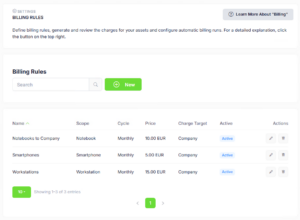
A billing run produces charge records: one line per device, per period, with the price, currency and target frozen at the moment of the run.

Billing rules defining a monthly price per device type and the cost target each is charged to

Raise a rate next quarter and last quarter’s figures do not move. When someone questions a charge eighteen months later, the record answers — not someone’s recollection. This is what makes chargeback defensible rather than merely calculated.
My Billing

The numbers go to the people they belong to

Cost centre owners, location owners, and — if you choose — end users open the portal and see what is about to be charged to them. Before it is charged.

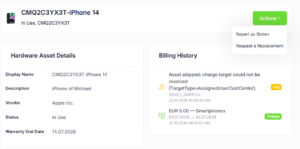
Asset detail page for a smartphone with hardware details, billing history and the Actions menu offering Report as Stolen and Request a Replacement

They can see when something is wrong. A laptop handed back months ago. A device that belongs to another team now. A person who changed departments. And they can say so, from that screen, without opening a ticket.

“I’m handing that control out. A manager or cost centre owner shouldn’t have to ask — we give it to them. That’s exactly where the value is.”
Michael Seidl, au2mator

This is the difference between chargeback as an accounting exercise and chargeback as something the organisation actually uses. The data gets better because the people who know the truth about a device can finally correct it.
Showback

Showback first, if you prefer

You do not have to invoice anyone to get value from this. Many organisations start with showback: the numbers are visible, nothing is actually charged internally. Departments see what their hardware costs, and conversations about refresh cycles and equipment requests change immediately.
The mechanics are identical. Whether the figure crosses into your finance system is your decision, not a technical constraint.
Data foundation

Where the data comes from

Chargeback is only as good as the asset data under it — which is why this is part of an asset management system rather than a billing tool. Devices come from your Intune import or other sources. Cost centres, locations and companies are part of your asset structure. Delegated maintenance keeps it current, because the people closest to the hardware can fix what they see.

What this is not:

  • Not a finance system. au2mator does not post to your ledger. It produces the allocation; what you do with it is yours.
  • Not cloud cost management. This is hardware. If you are looking for cloud spend and FinOps tagging, this is the wrong tool.
  • Not depreciation accounting. Charge records are an internal allocation, not a book value calculation.
Frequently Asked Questions

What you want to know.

What is IT hardware chargeback?
Hardware chargeback allocates the cost of devices — laptops, monitors, phones — to the department, cost centre or location that uses them, so hardware spend appears where it is caused rather than as one central IT budget line.
Chargeback actually moves the cost to the department’s budget. Showback makes the cost visible without transferring it. au2mator supports both: the calculation is the same, and whether the figure crosses into your finance system is your decision.
Yes. Charges can target a cost centre, a location or a company, depending on how your organisation is structured.
Nothing retroactive. Each charge record freezes the price, currency and target at the time of the billing run, so past periods keep their original figures and the new rate applies to future runs only.
Yes. My Billing shows cost centre owners, location owners and — optionally — end users what is about to be charged to them, before it is charged, and lets them flag a device that is no longer theirs.
Loan equipment, test devices and anything else you do not allocate go on an exclusion list and are skipped by every billing run.
No. au2mator produces the allocation and the per-device evidence behind it. Transferring figures into your ERP or finance system stays on your side.
No. This is hardware asset chargeback. Cloud spend allocation is a different discipline with different tooling.

See it with your own cost structure in mind

In a demo call we will go through how your cost centres map, what a billing run would produce, and what your department owners would see.
Asset Management is an add-on to the au2mator Self-Service Portal. See pricing and licensing